
Sustainable Manufacturing and Foundry Practices


Sudip Chattopadhyay1 and Arnab Sarkar2
1Department of Biochemistry, All India Institute of Medical Sciences, Kalyani, West Bengal, India
2Department of Mechanical Engineering, Indian Institute of Technology (BHU) Varanasi, Uttar Pradesh, India

This article is distributed under the terms of the Creative Commons Attribution-NonCommercial 4.0 License (https://creativecommons.org/licenses/by-nc/4.0/) which permits non-commercial use, reproduction and distribution of the work without further permission provided the original work is attributed as specified on the SAGE and Open Access page (https://us.sagepub.com/en-us/nam/open-access-at-sage).
Tea polyphenols are key bioactive constituents responsible for the health-promoting properties and quality attributes of tea. Rapid, reliable and cost-effective methods for their quantification are therefore essential for quality control and food analysis. In this work, a micro-fabricated disposable screen-printed electrochemical sensor was developed for the quantitative determination of tea polyphenols, using catechin as a representative standard compound. The electrochemical behaviour of catechin was investigated by cyclic voltammetry, revealing a well-defined anodic oxidation peak at +0.450 V, which was selected as the working potential for amperometry detection. The sensor exhibited a linear response towards catechin in the concentration range of 0-400 mg L-1 with excellent sensitivity. The limit of detection and limit of quantification were found to be 1.151 mg L-1 and 3.838 mg L-1, respectively. The analytical performance of the sensor was validated by comparison with high-performance liquid chromatography, showing strong agreement with a correlation coefficient of 0.994. Repeatability studies performed on 10 different tea samples demonstrated good precision, with coefficients of variation below 3%. The proposed micro-fabricated electrochemical sensor offers a simple, rapid and reliable alternative to conventional chromatographic methods for the determination of tea polyphenols and shows strong potential for on-site tea quality assessment and food analytical applications.
Polyphenols, screen-printed electrodes, cyclic voltammetry, amperometry
Introduction
Tea is one of the most widely consumed beverages worldwide and is highly valued for its characteristic flavour, aroma and significant health-promoting properties. These beneficial effects are primarily attributed to tea polyphenols, a complex group of phenolic compounds including catechins, flavonols and phenolic acids, which are known for their strong antioxidant, anti-inflammatory and chemoprotective activities (Balentine et al., 1997; Cabrera et al., 2006; Dufresne & Farnworth, 2001; Graham, 1992). The concentration and composition of tea polyphenols are therefore considered critical quality parameters for tea and tea-based products, necessitating reliable and efficient analytical methods for their quantification.
Conventional techniques for tea polyphenol analysis, such as spectrophotometric assays based on the Folin-Ciocalteu reagent, high-performance liquid chromatography (HPLC) and other chromatographic methods, are widely used due to their accuracy and selectivity (Prior et al., 2005; Singleton et al., 1999). However, these methods often involve time-consuming sample preparation, expensive instrumentation and limited portability, which restrict their application in rapid or on-site analysis. As a result, electrochemical methods have gained considerable attention as alternative analytical tools because of their high sensitivity, simplicity, rapid response and cost-effectiveness (Bard & Faulkner, 2001; Chevion & Or, 2005; Oliveira & Pimentel, 2009).
Electrochemical sensing of phenolic antioxidants relies on their inherent redox activity, enabling direct quantification using voltammetric techniques. Several studies have demonstrated the suitability of differential pulse voltammetry, linear sweep voltammetry and impedance-based approaches for evaluating the electrochemical behaviour and antioxidant capacity of polyphenolic compounds (Ping et al., 2015; Sánchez-Moreno, 2002). In particular, electrochemical sensors and biosensors have emerged as powerful tools in food and beverage analysis due to their adaptability, miniaturisation potential and compatibility with disposable electrode platforms (Mello & Kubota, 2002; Wang, 2006).
Significant efforts have been devoted to improving sensor performance through electrode surface modification using biological and chemical modifiers. Enzyme-modified electrodes employing tyrosinase extracted from crude sources have been successfully applied for the estimation of tea polyphenols via differential pulse voltammetry, exploiting the enzymatic oxidation of phenolic substrates (Chattopadhyay et al., 2015). Similarly, potato-extracted enzyme-modified electrodes combined with linear sweep voltammetry and electrochemical impedance spectroscopy have provided sensitive and mechanistic insights into tea polyphenol oxidation processes (Chattopadhyay & Sarkar, 2016). Alternative chemical modification strategies, such as the use of chloramines-T and ferric chloride, have also been shown to enhance sensitivity and reproducibility in tea polyphenol sensing (Chattopadhyay & Sarkar, 2014a; Sen et al., 2016). These studies clearly established the feasibility of electrochemical approaches for reliable quantification of tea polyphenols using modified electrode systems (Chattopadhyay & Sarkar, 2014b).
Among the various electrochemical platforms, screen-printed electrodes (SPEs) have attracted growing interest owing to their low cost, disposability, ease of mass production and suitability for miniaturised and portable sensing devices (Economou, 2010; Honeychurch, 2014; Metters et al., 2011; Renedo et al., 2007). SPE-based sensors have been extensively applied in environmental monitoring, clinical diagnostics and food analysis, including the detection of phenolic compounds and antioxidants (Apetrei & Apetrei, 2013; Pingarrón et al., 2008). Early investigations demonstrated the successful estimation of tea polyphenols using screen-printed electrochemical sensors, highlighting their potential for rapid and practical analysis (Chattopadhyay et al., 2014). The integration of micro-fabrication techniques with SPE technology further enables precise control over electrode geometry, improved reproducibility and enhanced electroanalytical performance.
Recent advances in electrochemical sensor design emphasise the development of compact, label-free and highly sensitive systems capable of on-site analysis with minimal sample preparation (Cheng & Yu, 2024; Li et al., 2022, 2023; Shao et al., 2022; Vestergaard et al., 2007). In this context, micro-fabricated screen-printed electrochemical sensors represent a promising approach for tea polyphenol quantification, combining the advantages of electrochemical detection with scalable manufacturing processes.
Building upon previous work on enzyme- and chemically modified electrodes as well as screen-printed sensor platforms, the present manuscript reports the development and application of micro-fabricated screen-printed electrochemical sensors for the quantification of tea polyphenols. The proposed approach aims to achieve enhanced sensitivity, reproducibility and operational simplicity, offering a robust analytical tool for tea quality assessment and related food analytical applications.
Experimental
Chemicals
Catechin (>=98%, TLC grade) was procured from Sigma (UK). A 0.1 M sodium phosphate buffer solution (pH 6.8) was prepared using disodium hydrogen phosphate, sodium dihydrogen phosphate and potassium chloride, all obtained from Merck (India). Milli-Q water (Millipore India Ltd., India) was used throughout for the preparation of buffer solutions. All other reagents employed in the study were of analytical grade and were purchased from Merck (India). Commercially available green and black tea samples were collected from local markets. For HPLC analysis, acetonitrile, acetic acid and water of HPLC grade were obtained from Merck (India).
Instrumentation
Electrochemical measurements, including amperometric responses, were carried out using an Autolab electrochemical analyser (PGSTAT 12, Ecochemie B.V., The Netherlands). The electrodes were connected to the corresponding terminals of the Autolab system through standard connectors. Experimental parameters such as scan rate, applied potential and measurement duration were controlled and recorded using General Purpose Electrochemical Software operated via a computer interfaced with the analyser.
Sensor Fabrication
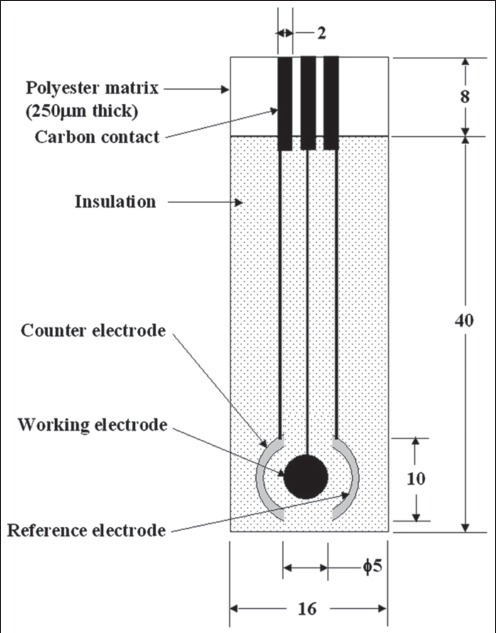
The sensing system was designed and fabricated for the electrochemical detection of tea polyphenols using a disposable SPE platform. The SPE consisted of a carbon working electrode, a carbon counter electrode and an integrated silver/silver chloride reference electrode. These electrodes were screen-printed onto a 250 µm thick polyester substrate (Cadillac Plastic Ltd., Swindon, UK) using a DEK 248 screen-printing machine (DEK Printing Machines Ltd., Weymouth, UK).
The circular electrocatalytic working electrode was fabricated using a commercially available carbon powder (MCA Services Ltd., Cambridgeshire, UK), which was converted into a screen-printable paste by mixing with 2.5% (w/v) hydroxyethyl cellulose (HEC) in phosphate-buffered saline (PBS) at a weight ratio of 1:3. The reference electrode ink comprised silver paste containing 15% (w/w) silver chloride (MCA, UK) (Singleton et al., 1999). The counter electrode and conductive tracks connecting the electrodes to the measurement system were printed using I45R carbon ink (MCA, UK).
To electrically insulate the basal tracks from the measurement solution, an epoxy-based protective coating ink (242-SB, Agmet ESL Ltd., Reading, UK) was applied. Following fabrication, the electrodes were thermally cured at 125 °C for 2 h to ensure proper curing of the epoxy resin and to enhance the mechanical stability and electrochemical durability of the electrocatalytic surface, enabling prolonged use in aqueous media. The detailed configuration of the sensing system is illustrated in Figure 1.
Preparation of Tea Extract
A variety of commercially available green and black tea samples were procured from the local market. The green tea samples included Tetley, Darjeeling Longview, Twinings, Japanese green tea, Golden Tips and Lipton, while the black tea samples comprised CTC, Tulip Bari, BOPL and Twinings. These samples were assigned identification numbers from 1 to 10, respectively, and stored in airtight containers until further use.
For extract preparation, 0.1 g of each tea sample was accurately weighed and transferred to a beaker. Subsequently, 5 mL of freshly boiled distilled water was added, and the mixture was allowed to infuse for 5 min. The infusion was then filtered to remove insoluble residues, and the resulting supernatant was used directly as the sample for electrochemical measurements.
Electrochemical Measurement
Cyclic voltammetry was employed to investigate the electrochemical behaviour of catechin and to determine the optimal oxidation potential for subsequent amperometric measurements. The experiments were carried out using a 200 mg L-1 catechin solution prepared in 0.1 M phosphate buffer solution (PBS, pH 6.8). The voltammograms were recorded over a potential window ranging from -1.0 V to +1.0 V at a scan rate of 0.001 V s-1, with a step potential of 0.00305 V. For comparison, cyclic voltammetric measurements were also performed using a blank solution consisting of 5 mL of 0.1 M PBS mixed with 0.5 mL of reverse osmosis (RO) water under identical experimental conditions.
High-performance Liquid Chromatography Analysis
HPLC was employed as an independent and well-established analytical technique to validate the results obtained from the electrochemical detection of tea polyphenols. Catechin was used as the representative polyphenol standard for validation, owing to its predominance in tea and its well-characterised chromatographic behaviour. HPLC analysis was carried out using a Varian LC system (USA) comprising a ProStar 230 solvent delivery module coupled with a ProStar 330 photodiode array (PDA) detector. Chromatographic separation of phenolic compounds was achieved on an OmniSpher C18 reversed-phase column (25 cm ´ 4.6 mm, Varian, USA), which was protected by a ChromSep guard column (1 cm ´ 3 mm, Varian, USA). The use of a PDA detector enabled reliable detection and quantification of catechin based on its characteristic UV-visible absorbance, thereby providing a robust reference method for comparison with electrochemical sensor data.
For HPLC analysis, an accurately weighed 0.1 g of each tea sample was infused with 5 mL of freshly boiled distilled water in a boiling water bath for 5 min. The infusion was allowed to cool to room temperature and then filtered through filter paper to remove suspended solids.
The filtrate was subjected to a decaffeination step by liquid-liquid extraction with an equal volume of chloroform. After phase separation, the lower chloroform layer was carefully discarded. This extraction procedure was repeated twice to ensure efficient removal of caffeine, following the reported method (Copeland et al., 1997).
The decaffeinated aqueous phase was subsequently extracted with ethyl acetate. The ethyl acetate layer was collected in Eppendorf tubes and evaporated overnight at 45 °C to remove the solvent. The resulting dried residue was reconstituted in HPLC-grade water and injected into the HPLC system for analysis. Chromatographic separation and quantification were performed according to a previously reported method (Liang et al., 2001).
Results and Discussion
Electrochemical Study
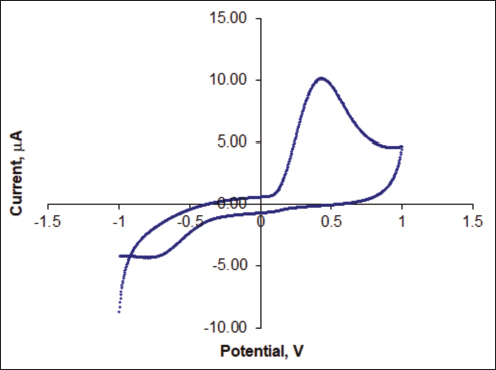
The cyclic voltammograms of catechin exhibited a well-defined anodic peak, confirming the electroactive nature of catechin at the fabricated sensor surface. The anodic oxidation peak was observed at approximately +0.450 V (vs Ag/AgCl), corresponding to the electrochemical oxidation of phenolic hydroxyl groups present in catechin molecules (Figure 2).
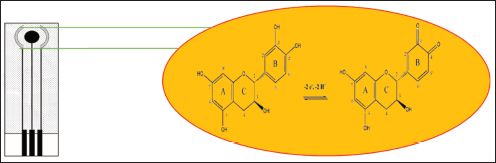
This potential was identified as the optimum oxidation potential, as represented in Figure 3, and was subsequently selected as the working potential for amperometric measurements.
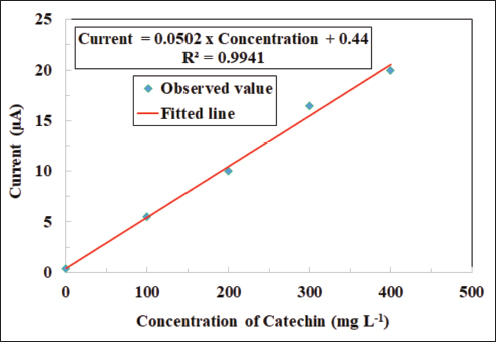
To further evaluate the electrochemical response of the sensor towards varying catechin concentrations, amperometric responses were recorded for catechin solutions in the concentration range of 0-400 mg L-1 under the same experimental conditions. As shown in Figure 4, the anodic peak current increased progressively with increasing catechin concentration, indicating a concentration-dependent electrochemical response. The well-defined and reproducible oxidation peaks demonstrate efficient electron transfer at the electrode interface and confirm the suitability of the fabricated sensor for quantitative determination of catechin and related tea polyphenols.
Validation and Statistical Analysis
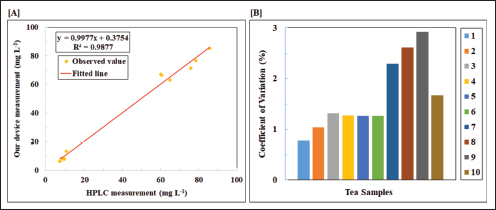
To validate the quantification of catechin (total polyphenols) in tea samples, the analytical performance of the proposed electrochemical sensor was evaluated by comparing it with the reference HPLC method. The results obtained from both techniques exhibited a strong linear relationship, with a coefficient of determination (R2) of 0.9877 and a correlation coefficient of 0.994, indicating excellent agreement between the two methods. The sensor demonstrated an LOD of 1.151 mg L-1 and a LOQ of 3.838 mg L-1. The catechin concentrations determined using HPLC closely matched those measured using the electrochemical platform, confirming the reliability and accuracy of the proposed sensor. The high correlation coefficient, approaching unity, further substantiates the strong agreement between the electrochemical and HPLC results, as illustrated in Figure 5A.
The repeatability of the electrochemical measurements was assessed by calculating the coefficient of variation (CV) for catechin determination in ten different tea samples. Each sample was analysed in triplicate using the fabricated sensor. As shown in Figure 5B, the CV values are <3% across all samples, demonstrating excellent precision and good repeatability of the proposed electrochemical sensing platform.
Conclusion
A micro-fabricated screen-printed electrochemical sensor was successfully developed for the quantitative determination of tea polyphenols using catechin as a model compound. Cyclic voltammetric studies confirmed the electroactive nature of catechin, with a well-defined oxidation peak at +0.450 V, enabling sensitive amperometric detection. The sensor exhibited a wide linear response range, low detection and quantification limits and excellent repeatability across multiple tea samples. Validation against HPLC analysis demonstrated strong agreement between the two methods, confirming the accuracy and reliability of the proposed electrochemical platform. The low cost, disposability, simplicity of operation and rapid response of the sensor make it well-suited for routine analysis and on-site monitoring of tea polyphenols. Overall, this study highlights the potential of micro-fabricated screen-printed electrochemical sensors as practical analytical tools for tea quality control and broader food analysis applications.
Authors’ Contributions
Sudip Chattopadhyay: Conceptualisation, data curation, formal analysis, validation, visualisation and writing—original draft.
Arnab Sarkar: Writing—review and editing.
The authors declared no potential conflicts of interest with respect to the research, authorship and/or publication of this article.
The authors received no financial support for the research, authorship and/or publication of this article.
Sudip Chattopadhyay https://orcid.org/0000-0001-6536-9130
Arnab Sarkar https://orcid.org/0009-0002-6076-7943
Apetrei C., & Apetrei I. M. (2013). Application of voltammetric electronic tongue for the detection of polyphenolic compounds. Sensors, 13, 13220–13233.
Balentine D. A., Wiseman S. A., & Bouwens L. C. (1997). The chemistry of tea flavonoids. Critical Reviews in Food Science and Nutrition, 37, 693–704.
Bard A. J., & Faulkner L. R. (2001). Electrochemical methods: Fundamentals and applications (2nd ed.). Wiley.
Cabrera C., Artacho R., & Giménez R. (2006). Beneficial effects of green tea—A review. Journal of the American College of Nutrition, 25, 79–99.
Chattopadhyay S., & Sarkar P. (2014a). Estimation of tea polyphenols by electrochemical sensors via ferric chloride modified electrodes. Journal of the Indian Chemical Society, 91, 2291–2298.
Chattopadhyay S., & Sarkar P. (2014b). Electrochemical sensors for measurement of tea polyphenols by differential pulse voltammetry. International Journal of Advanced Information Science and Technology, 27, 29–39.
Chattopadhyay S., & Sarkar P. (2016). Linear sweep voltammetry and impedometric analysis of tea polyphenols with potato–extracted enzyme modified electrode. Analytical and Bioanalytical Electrochemistry, 8, 268–286.
Chattopadhyay S., Sarkar P., & Chaudhuri U. R. (2014). Estimation of tea polyphenols by electrochemical sensors via screen printed electrodes. International Journal of Innovative Science, Engineering & Technology, 1, 406–413.
Chattopadhyay S., Sarkar P., & Chudhury U. R. (2015). Estimation of tea polyphenols by differential pulse voltammetry with electrodes modified by tyrosinase extracted from crude sources. Journal of The Electrochemical Society, 162, B101–B108.
Cheng Y., & Yu J. (2024). Electrochemical sensor with electrohydrodynamic–printed microelectrodes for the detection of low concentration of tea polyphenols. Sensors and Actuators A: Physical, 365, 114912.
Chevion S., & Or R. (2005). Electrochemical evaluation of antioxidant capacity of polyphenols. Free Radical Biology and Medicine, 38, 1481–1490.
Copeland E. L., Clifford M. N., & Williams C. M. (1997). Preparation of (–)–epigallocatechin gallate from commercial green tea by caffeine precipitation and solvent partition. Food Chemistry, 61, 81–87.
Dufresne C. J., & Farnworth E. R. (2001). A review of latest research findings on the health promotion properties of tea. Journal of Nutritional Biochemistry, 12, 404–421.
Economou A. (2010). Screen–printed electrodes modified with ‘green’ metals for electrochemical stripping analysis. TrAC Trends in Analytical Chemistry, 29, 1002–1011.
Graham H. N. (1992). Green tea composition, consumption, and polyphenol chemistry. Preventive Medicine, 21, 334–350.
Honeychurch K. C. (2014). Screen–printed electrochemical sensors and biosensors for monitoring metal pollutants. Biosensors, 4, 1–51.
Li X., Jiang C. L., Kong Y. S., Luo J. L., Yin P., & Guo G. Y. (2022). Recent advances in analytical methods for determination of polyphenols in tea: A comprehensive review. Foods, 11, 1321.
Li Y., Chen X., Lin Y., Yang Y., Zhang L., Zhao P., Wang C., Fei J., & Xie Y. (2023). Detection of catechins in tea beverages using a novel electrochemical sensor based on cyclodextrin nanosponges composite. eFood, 4, e64.
Liang Y. R., Ma W. Y., Lu J. L., & Wu Y. (2001). Comparison of chemical compositions of Ilex latifolia Thumb and Camellia sinensis L. Food Chemistry, 75, 339–343.
Mello L. D., & Kubota L. T. (2002). Review of the use of biosensors as analytical tools in the food and drink industries. Food Chemistry, 77, 237–256.
Metters J. P., Kadara R. O., & Banks C. E. (2011). New directions in screen printed electroanalytical sensors. Electroanalysis, 23, 2541–2553.
Oliveira S. C. B., & Pimentel D. M. (2009). Electrochemical behavior of polyphenolic antioxidants. Electroanalysis, 21, 123–130.
Ping J., Wu J., Wang Y., & Ying Y. (2015). Electrochemical sensing of food antioxidants: A review. Food Chemistry, 177, 173–184.
Pingarrón J. M., Yáñez–Sedeño P., & González–Cortés A. (2008). Gold nanoparticle–based electrochemical biosensors. Electrochimica Acta, 53, 5848–5866.
Prior R. L., Wu X., & Schaich K. (2005). Standardized methods for the determination of antioxidant capacity and phenolics in foods and dietary supplements. Journal of Agricultural and Food Chemistry, 53, 4290–4302.
Renedo O. D., Alonso–Lomillo M. A., & Martínez M. J. A. (2007). Recent developments in the field of screen–printed electrodes and their related applications. Talanta, 73, 202–219.
Sánchez–Moreno C. (2002). Methods used to evaluate the free radical scavenging activity in foods and biological systems. Food Science and Technology International, 8, 121–137.
Sen S., Chattopadhyay S., & Sarkar P. (2016). Electrochemical sensing of tea polyphenols by chloramines–T modified electrodes: A new approach. Journal of The Electrochemical Society, 163, B49–B55.
Shao J., Wang C., Shen Y., Shi J., & Ding D. (2022). Electrochemical sensors and biosensors for the analysis of tea components: A bibliometric review. Frontiers in Chemistry, 9, 818461.
Singleton V. L., Orthofer R., & Lamuela–Raventós R. M. (1999). Analysis of total phenols and other oxidation substrates by means of Folin–Ciocalteu reagent. Methods in Enzymology, 299, 152–178.
Vestergaard M., Kerman K., & Tamiya E. (2007). An overview of label–free electrochemical protein sensors. Sensors, 7, 3442–3458.
Wang J. (2006). Electrochemical biosensors: Towards point–of–care cancer diagnostics. Biosensors and Bioelectronics, 21, 1887–1892.
